
Imagine the cockpit of a P-47 on New Year’s Day, 1945, where the air is crystalline but the horizon is thick with the smoke of Operation Bodenplatte. It isn't the glory of the ace that weighs on you. Instead, it's the cold, mechanical reality of a machine designed to kill and a conscience struggling to stay aloft. If you've spent hours searching for historical fiction about pilots WWII, you've likely grown weary of "pulp" narratives that treat dogfights like sporting matches. You deserve more than a list of kill counts or technical manuals disguised as stories. You're seeking the internal friction of a protagonist who knows that every victory carries a heavy moral price.
This article reveals the most immersive WWII aviation novels that refuse to sacrifice historical truth for simple heroics. We'll explore works that balance rigorous technical precision with the profound psychological toll of aerial combat. By examining narratives that feel both cinematic and scholarly, you'll discover how the best authors capture the visceral reality of the human spirit within the crucible of war. We'll look at stories that treat the cockpit not as a stage for heroics, but as a crucible for the human soul amidst the gravity of the ugly skies.
Key Takeaways
- Understand why the most compelling historical fiction about pilots WWII explores the psychological isolation of the cockpit rather than just the mechanics of flight.
- Learn to distinguish between "rivet-counting" technical manuals and narratives that use historical accuracy to heighten the emotional stakes of aerial combat.
- Compare the harrowing reality of carrier-based warfare in the Pacific with the brutal, thousand-bomber raids over the European theater.
- Identify the hallmarks of a scholarly storyteller to ensure your next read offers both cinematic atmosphere and deep historical rigor.
- Discover how The Ugly Skies on New Years provides a somber, character-driven perspective on the air war during the Battle of the Bulge.
The Cinematic Gravity of WWII Aviation Fiction
The allure of the air war is a study in contradictions. It offers a vantage point of terrifying beauty, where the curvature of the earth meets the smoke of burning cities. For those who seek historical fiction about pilots WWII, the appeal isn't found in simple heroics. It's found in the crushing isolation of the cockpit. Thousands of feet above the earth, a pilot is both an engine of destruction and a fragile soul held aloft by aluminum and hope. This genre serves as a crucible for high-stakes decision-making. Every twitch of the stick or squeeze of the trigger carries a weight that the ground soldier, buried in the mud, might never fully grasp. It's a lonely war.
In our modern era, readers are increasingly drawn to these narratives because they represent the ultimate struggle for individual agency. Amidst a global conflict involving millions, the pilot remains a singular figure. They're masters of their own fate until the moment they aren't. It's a somber reality. The sky was never a playground. It was a place where human ambition collided with the cold physics of industrial warfare. The vastness of the horizon only served to highlight the cramped, oil-streaked reality of the man inside the machine.
Why the Air War Remains a Literary Pillar
The air war represents a pivotal moment in human history; it's the point where 19th-century notions of chivalry were finally consumed by 20th-century industrial slaughter. Early in the conflict, some still clung to the idea of the "knight of the air," looking back at the WWII flying aces as modern-day aristocrats. However, the reality was far more clinical and devastating. Flight is the ultimate symbol of human ambition, yet in these stories, it frequently serves as a backdrop for profound failure. The pilot's perspective is uniquely detached. They see the war as a map, yet they're the ones who redraw its borders with fire.
The Balance of Fact and Atmosphere
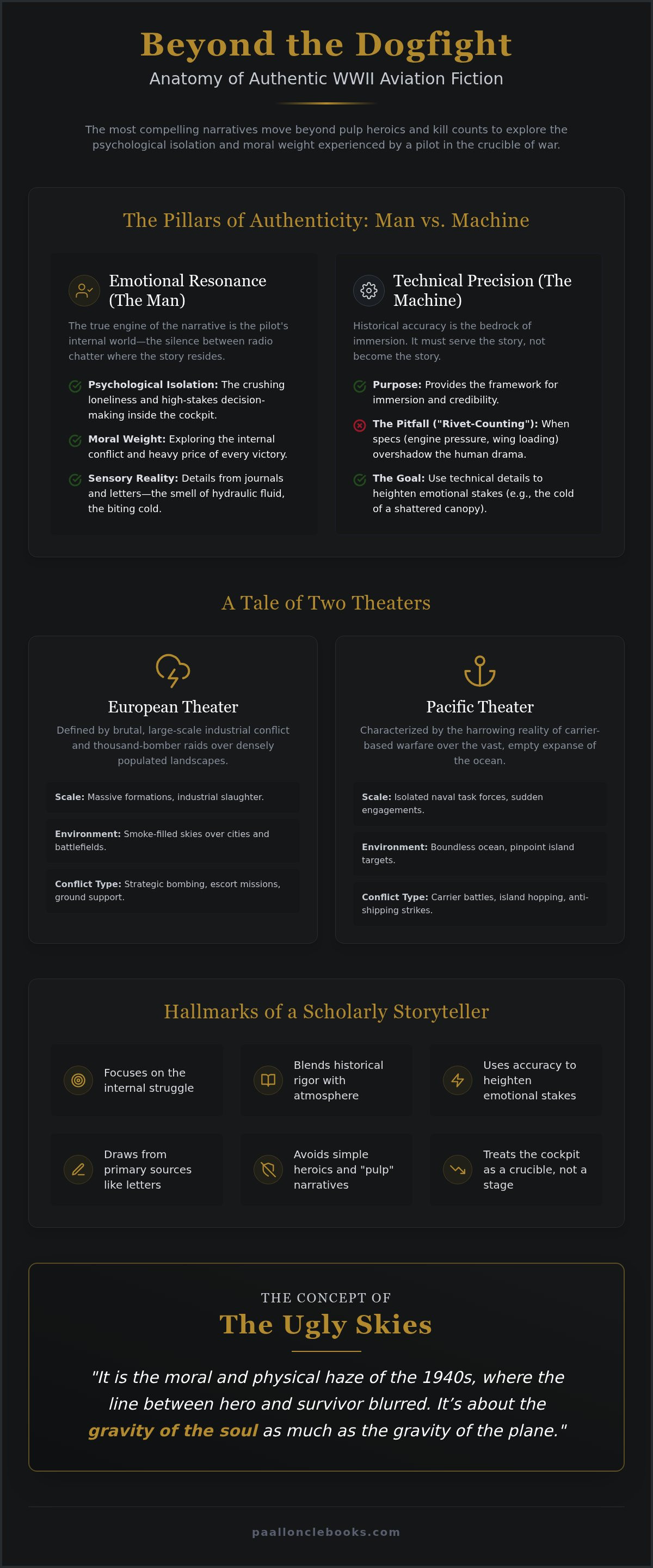
Great fiction requires more than a list of engine specifications or fuel capacities. While technical precision is vital, it must serve the atmosphere. A scholarly storyteller knows that a perfectly described cockpit is meaningless if the reader doesn't feel the biting cold of a shattered canopy. This is what defines the "ugly skies." It's the moral and physical haze of the 1940s, where the line between hero and survivor blurred. In works like The Ugly Skies on New Years, the focus shifts from the glory of the kill to the internal struggle of the man behind the sights. This balance of historical rigor and emotional depth is what transforms a simple war story into a lasting piece of literature. It's about the gravity of the soul as much as the gravity of the plane.
Technical Precision vs. Emotional Resonance in Pilot Novels
A common pitfall in military literature is the "rivet-counter" trap. This occurs when an author becomes so enamored with the manifold pressure of a Merlin engine or the specific wing loading of a Messerschmitt that they forget the trembling hand on the throttle. While technical data provides a framework, it doesn't breathe life into the narrative. For those seeking historical fiction about pilots WWII, the most resonant stories are those where the machine serves as an extension of the character's internal conflict. Precision in the cockpit is essential; however, it's the silence between the radio chatter where the real story resides.
Accurate flight physics and authentic cockpit layouts are the baseline requirements for immersion. If a pilot reaches for a lever that didn't exist in 1944, the spell is broken. Yet, the true engine of the narrative is the internal monologue. It's the calculation of risk, the suppression of terror, and the quiet penance of a man who knows his next mission might be his last. When we read about the air war, we're looking for the intersection of mechanical certainty and human doubt. The soul of the story isn't found in the aircraft's specifications, but in the pilot's willingness to push that aircraft into the unknown.
Researching the Soul of a Pilot
Historical authenticity is a delicate blend of verifiable fact and unrecorded feeling. To capture this, a writer must look past the official flight manuals and delve into the private world of personal journals and letters. These documents reveal the sensory reality of the era. It's the pervasive smell of hydraulic fluid and stale coffee. It's the way the cold bites through a leather flight suit at thirty thousand feet. It's the bone-deep vibration of the engine that becomes the pilot's heartbeat. These details transform a flat description into a visceral experience that lingers long after the book is closed.
The Burden of Command and Combat
The "hero" myth often sanitizes the psychological toll of leadership. Leading a squadron into the "ugly skies" meant carrying the weight of men who wouldn't return. This burden of command is a fertile ground for exploring ambition and failure. When a mission goes wrong, the pilot must survive not just the enemy fire, but the crushing aftermath of his own decisions. This reality creates a war-worn aviator far more complex than any one-dimensional protagonist found in generic thrillers. If you appreciate this level of psychological depth, you might find the work of Paal Loncle particularly engaging. It's in these moments of failure that the human spirit is most clearly defined.
Exploring the Theaters: From the Pacific to the Battle of the Bulge
The theater of operation dictates the soul of the story. In the vast landscape of historical fiction about pilots WWII, the setting is never merely a backdrop; it's a relentless antagonist that shapes the protagonist's internal moral conflict. Whether it's the endless, shimmering blue of the Pacific or the soot-stained clouds over the Ruhr Valley, the environment imposes its own unique psychological toll. The mood of a novel shifts with the geography. A story set in a carrier cockpit feels claustrophobic despite the open horizon, while a bomber narrative over Germany is defined by a slow, grinding sense of inevitable attrition.
Readers often gravitate toward the European Bomber Command for its harrowing scale. The "thousand-bomber" raids weren't just tactical maneuvers. They were industrial-scale events that forced crews to endure hours of sub-zero temperatures and steady flak. Conversely, the Pacific Theater offered a different kind of terror. Here, the ocean was an unforgiving void. To ditch was to vanish. This geographical reality created a specific brand of stoicism among naval aviators, one where the moving deck of a carrier represented the only sliver of safety in a merciless world.
The Frozen Skies of the Ardennes
The winter of 1944-1945 remains one of the most compelling periods for aviation literature, specifically during the Ardennes Offensive. The Battle of the Bulge is often remembered for the frozen infantry in the foxholes, yet the air war was equally desperate. On New Year’s Day, 1945, the Luftwaffe launched Operation Bodenplatte. It was a final, frantic gamble to reclaim air superiority. This intersection of ground combat and aerial support amidst the winter snows provides a somber, cinematic canvas. It highlights the "ugly skies" where visibility was a luxury and every low-level strafing run was a brush with death. It's a setting that strips away the myth of the ace and replaces it with the reality of the survivor.
Naval Aviation and Carrier Strikes
Naval aviation introduces a mechanical tension that land-based stories lack. The challenge of landing a damaged Wildcat or Hellcat on a pitching deck in high seas is a feat of pure, adrenaline-fueled physics. Late-war Pacific narratives also grapple with the psychological pressure of the kamikaze threat. This wasn't standard combat; it was a collision with a philosophy of total destruction. A primary example of this tension is often described as the "Silver Waterfall"-the terrifyingly beautiful sight of dive bombers descending in a coordinated strike. It represents the peak of naval aviation tension, where a few minutes of vertical flight could alter the course of an entire empire. The setting demands a protagonist who is as much a mathematician as a warrior.
How to Choose Your Next WWII Pilot Novel
Selecting the right volume of historical fiction about pilots WWII requires a discerning eye. The market is often crowded with "pulp" narratives that prioritize the adrenaline of the dogfight over the dignity of historical truth. To find a book that truly resonates, you must look for the "scholarly storyteller." This is an author who treats the past with the reverence it deserves, moving beyond the mechanical fascination of flight to explore the internal friction of the human soul. You aren't just looking for a story about planes; you're looking for a story about the men who were consumed by them.
Begin by evaluating the author's background and their approach to the era. A dedicated student of history will weave the "weight" of the global conflict into every page. They avoid the trap of one-dimensional heroics. Instead, they focus on character-driven narratives where the protagonist's moral conflict is as dangerous as the enemy fire. The prose should be cinematic, evoking the grime and gravity of the 1940s without the intrusion of modern slang or contemporary sensibilities. It's a delicate balance. The goal is to find a narrative that feels both immersive and intellectually rigorous.
The Checklist for Historical Rigor
When browsing for your next read, look for specific markers of quality that separate serious literature from generic war fiction. A rigorous author often provides a glimpse into their research process, citing the journals or historical events that inspired the work. Pay close attention to the dialogue. It should reflect the formal register and specific cultural nuances of the 1940s. If the characters sound like they belong in a 2026 action movie, the historical immersion is lost. Additionally, don't overlook the role of independent authors. These writers often bring underrated or "ugly" stories to light, exploring corners of the air war that mainstream publishers might find too somber or complex.
Matching the Book to Your Mood
Your choice should also align with the emotional experience you seek. There's a time for high-octane tactical thrillers, but for the history lover or educator, a somber and reflective drama often provides more lasting value. These stories frequently center on controversial figures or doomed military leaders, offering a window into the psychological reality of failure and ambition. If you're ready to move past superficial action and engage with the true gravity of the air war, you can explore the historical novels of Paal Loncle. These works are designed for readers who value depth, atmosphere, and the uncompromising truth of the "ugly skies."
The Ugly Skies on New Years: A New Perspective on the Air War
Among the vast library of historical fiction about pilots WWII, few works capture the intersection of mechanical terror and human frailty as vividly as The Ugly Skies on New Years. This narrative isn't a celebration of tactical brilliance; it's a somber exploration of the Ardennes winter. As the Battle of the Bulge reached its freezing crescendo, the air war became a theater of desperate gambles and profound moral weight. Paal Loncle positions the reader directly inside the cockpit, where the biting cold of the cockpit is matched only by the protagonist's internal struggle. It's a story defined by ambition and the crushing reality of failure.
The protagonist's journey serves as a vessel for the themes of penance and resilience. In this novel, the "ugly skies" aren't just a physical environment; they represent the moral haze of a conflict where survival is the only remaining virtue. For readers who seek cinematic gravity, this book offers a lens into the psychological reality of the men who flew during Operation Bodenplatte. It's a definitive choice for those who want to understand the air war as a crucible for the human soul. The mission isn't just to survive the enemy; it's to survive the aftermath of one's own choices.
Atmospheric Storytelling at its Peak
Loncle utilizes the setting of New Year’s Eve to create a haunting contrast. While the world below might grasp at the hope of a new beginning, the pilots in the sky are locked in a final, industrial-scale slaughter. The prose reflects this tension through a rhythmic variation. Expansive, atmospheric descriptions of the crystalline winter sky are frequently punctuated by sharp, functional directives of combat. This style creates an immersive experience that honors the complexity of the era. It's a hallmark of the scholarly storyteller, ensuring that every detail, from the vibration of the airframe to the smell of hydraulic fluid, is rooted in historical rigor. This novel is a must-read for those who value depth over superficial action.
Engage with the History
The journey doesn't end with the final page. To truly understand the research and the "ugly" realities of the 1940s, you're invited to engage further with the historical context. You can sign up for the author's newsletter to receive deep-dive insights into the research process and the forgotten stories of the Ardennes. Additionally, Paal Loncle offers author talks and events specifically tailored for history groups and educational organizations. These sessions bridge the gap between the creative flair of the novelist and the structured approach of the educator. If you're ready to move beyond the hero myth, you can experience the weight of the Ardennes in 'The Ugly Skies on New Years'. Discover a narrative that treats the past with the intellectual dignity it deserves.
Witness the True Gravity of the Skies
The journey through the clouds is never just about the machine; it's about the soul navigating the storm. We've explored how the most enduring historical fiction about pilots WWII transcends technical manuals to capture the visceral weight of isolation and the high stakes of moral choice. Whether navigating the unforgiving Pacific or the frozen haze of the Ardennes, a great novel ensures that technical precision serves the emotional truth. You deserve a narrative that treats history with the intellectual dignity it demands.
When you seek your next immersive read, look for the hand of a scholarly storyteller who honors the complexity of the past. Paal Loncle, a professional educator and historian, brings this rigor to every page. His cinematic prose captures the somber reality of the Ardennes with a dignity that generic war fiction often lacks. You don't have to settle for flat heroics when you can experience the profound psychological toll of the air war. Secure your copy of 'The Ugly Skies on New Years' today through direct retail links. Step into the cockpit and discover a story that stays with you long after the engines have gone silent.
Frequently Asked Questions
What makes a WWII pilot novel 'historically accurate'?
Historical accuracy is a synthesis of mechanical fact and human experience. It requires a writer to verify technical specifications, such as cockpit layouts and flight physics, while simultaneously capturing the sensory reality of the 1940s. A truly accurate novel doesn't just list engine types; it describes the biting cold of a shattered canopy and the pervasive scent of hydraulic fluid that defined a pilot's existence.
Are there any good historical fiction books about the Luftwaffe pilots?
Several compelling works explore the German perspective, often focusing on the internal moral conflict of men caught within a collapsing regime. These narratives highlight the "ugly" realities of the war's final days, where pilots faced overwhelming odds and the weight of their own choices. These stories provide a somber, reflective look at the air war from the other side of the horizon.
What is the best novel about the Battle of the Bulge air war?
The Ugly Skies on New Years stands as a definitive exploration of this specific and harrowing theater. It captures the atmospheric gravity of the Ardennes winter and the desperation of the New Year’s Day air offensive. By focusing on the intersection of ground combat and aerial support, the novel offers a cinematic vantage point that honors the complexity of the 1945 offensive.
How do authors research the technical details of WWII fighter planes?
Authors utilize a rigorous combination of primary sources, including original flight manuals for aircraft like the P-47 or Bf 109, and secondary sources such as pilot memoirs. This research process ensures that every mechanical detail, from the vibration of the airframe to the specific radio chatter, is authentic. This scholarly approach allows the writer to bridge the gap between historical data and emotional truth.
Are there WWII pilot novels that focus on psychological trauma rather than just combat?
Modern historical fiction about pilots WWII increasingly prioritizes the internal "weight" of combat over simple dogfights. These narratives examine the profound isolation of the cockpit and the enduring psychological trauma of high-stakes decision-making. The best authors treat the air war as a crucible for the human soul, exploring how pilots survived the aftermath of their missions as much as the missions themselves.
Can historical fiction be used as an educational tool for WWII history?
When crafted with scholarly rigor, historical fiction serves as a vital bridge to deeper historical understanding. It allows students and history lovers to engage with the human spirit behind the dry data points of global conflict. By humanizing the past, these stories encourage intellectual curiosity and provide a more nuanced perspective on the moral and physical haze of the 1940s.
What are some underrated historical fiction books about WWII aviation?
Underrated gems in the genre of historical fiction about pilots WWII often come from independent authors who prioritize character-driven depth over generic action. These works frequently explore "ugly" or forgotten corners of the war, such as the brutal winter offensives or the psychological toll of naval aviation. Seeking out these stories ensures a reading experience that is both cinematic and intellectually rewarding.
Why is the New Year's Day air offensive of 1945 a common theme in fiction?
Operation Bodenplatte offers a haunting, cinematic contrast between the traditional hope of a new year and the finality of industrial destruction. It represents the Luftwaffe's final, desperate gamble for individual agency amidst an inevitable defeat. This specific historical moment provides a somber canvas for exploring themes of ambition, failure, and the relentless gravity of the "ugly skies" during the war's end.


