
A history book talk isn't a mere summary of events; it's a cinematic bridge that connects the cold data of the archive to the living pulse of human experience. You've likely stood before a silent classroom where the weight of the past felt like little more than dust and dates. It's a common struggle to make students feel the urgency of a WWII dogfight or the quiet desperation of a frontier winter when the text lacks a human heartbeat. You want to honor the facts, but you also want your students to feel the high stakes of historical conflict. Delivering a compelling book talk for history classes requires more than just a list of chapters. It demands a narrative hook that anchors the soul to the timeline.
In this article, you'll discover how to transform historical facts into immersive classroom experiences that bridge the gap between the archive and the human spirit. We'll explore a clear framework for presenting both fiction and non-fiction with professional authority and intellectual rigor. You'll also learn how to use cinematic storytelling to engage with primary sources and how to bring seasoned author voices into your curriculum to ignite a genuine passion for the past. By the end, you'll have the tools to turn a standard lesson into a profound exploration of human nature.
Key Takeaways
- Learn why a narrative book talk for history classes succeeds by prioritizing the human pulse of an era over a dry list of chronological dates.
- Master the "Cold Open" technique to drop students into high-stakes historical moments that build immediate atmospheric tension and intellectual curiosity.
- Discover the "Historian’s Guardrail" to navigate the delicate balance between compelling narrative fiction and rigorous academic accuracy.
- Implement a structured framework for selecting historical pivot points and curating primary source artifacts that ground your storytelling in physical reality.
- Explore how professional author talks provide a unique practitioner’s perspective that elevates the curriculum through the lens of deeply researched historical conflict.
Beyond the Syllabus: What is a Narrative Book Talk for History?
To understand the past, we must first feel its gravity. A narrative book talk isn't a dry recitation of dates or a clinical analysis of geopolitical shifts. Instead, it's a curated, high-impact presentation designed to evoke the heavy, tangible atmosphere of a historical era. Unlike a standard academic summary, this approach prioritizes the "human pulse," focusing on the internal struggles and impossible choices of those who lived through the conflict. A narrative book talk for history classes serves as a gateway to historiography through the lens of storytelling, transforming the archive into a living, breathing landscape.
When considering the question What is a book talk?, it's often viewed through a library or literacy lens. However, in the context of a history curriculum, the definition evolves into something more cinematic. It becomes a bridge between the cold data of the textbook and the emotional weight of human experience. The goal is to spark a profound intellectual curiosity and a sense of "being there" in the moment of conflict, where the outcomes were not yet written in stone.
The Purpose of the Presentation in a History Curriculum
History is often taught as a series of inevitable outcomes. This clinical approach strips the past of its tension. By humanizing historical figures, we make their choices feel urgent and contemporary. Students begin to see that figures like those found in The Ugly Skies on New Years weren't just names on a page; they were individuals grappling with ambition, fear, and the weight of their own era. This shift encourages students to question the "why" behind the "what," moving past simple memorization to a deeper intellectual inquiry that bridges the gap between dry data and the human spirit.
Why Traditional Book Reports Fail to Engage
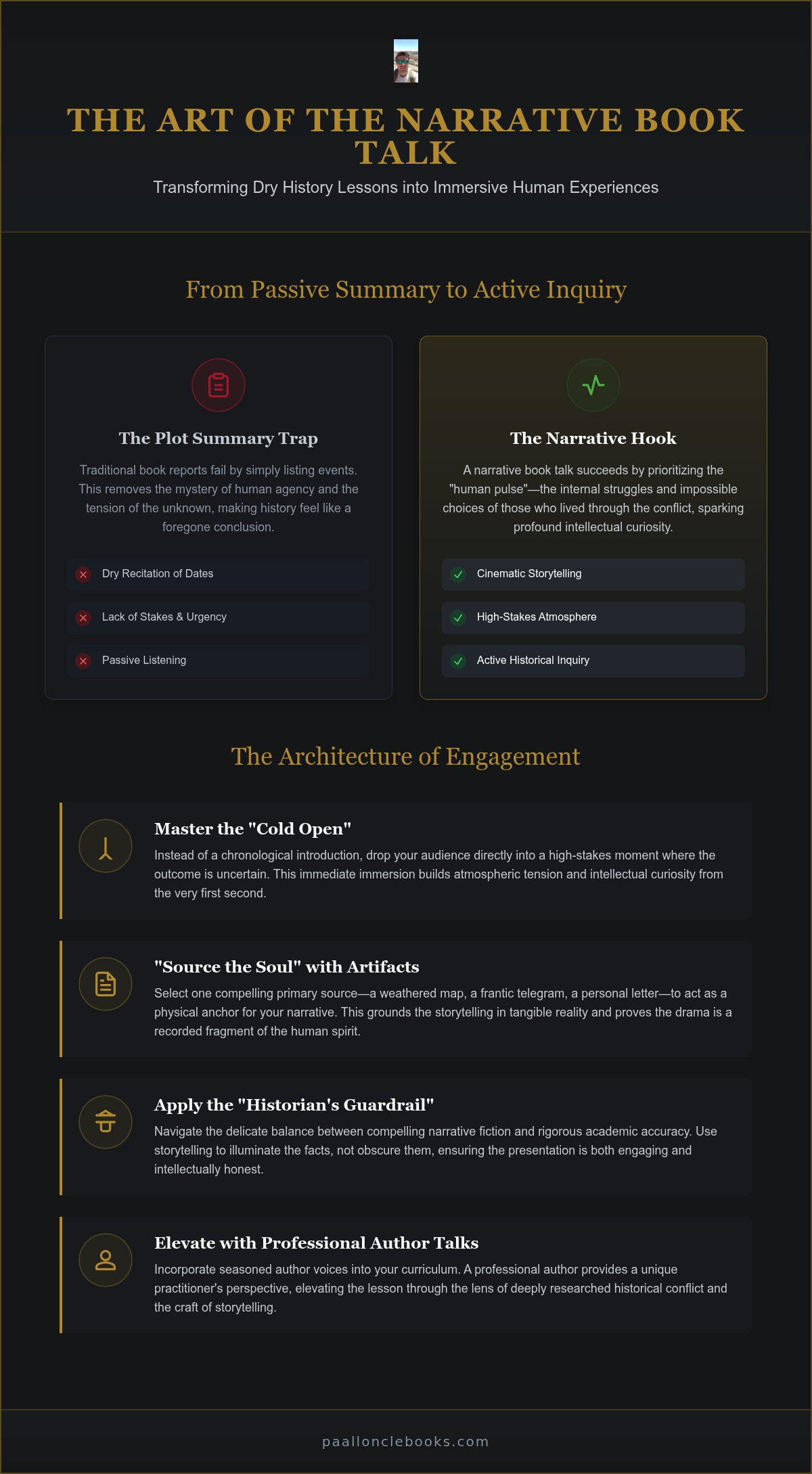
The traditional book report often falls into the "Plot Summary Trap." When a student simply lists events, the inherent drama of the era evaporates. The past loses its stakes. To truly engage, a book talk for history classes must introduce "dramatic urgency." Without this, the narrative feels distant and irrelevant.
- The Plot Summary Trap: Listing "what happened" removes the mystery of human agency and the tension of the unknown.
- Lack of Stakes: Without understanding the cost of failure, historical events feel like a foregone conclusion rather than a struggle.
- Passive vs. Active: Moving from passive listening to active historical inquiry requires a hook that demands an emotional and intellectual response.
The objective is to foster a state of engagement where the student isn't just an observer, but a witness to the complexities of history. This isn't about entertainment. It's about a serious-minded dedication to the craft of history, presenting the past as a credible and thoughtful exploration of the human condition.
The Architecture of Engagement: Designing Your Historical Narrative
The structural integrity of a narrative determines whether it resonates or fades into the background noise of a busy school day. To capture the imagination, you must design your presentation with the same care a novelist uses to build a world. This architecture begins with a "Cold Open." Instead of a chronological introduction, drop your audience directly into a high-stakes moment where the outcome is uncertain. This immediate immersion is the hallmark of an effective book talk for history classes; it forces students to engage with the tension of the moment rather than the safety of hindsight. It's about creating a visceral connection to the past that a textbook simply cannot achieve.
Once the scene is set, utilize the "Sourcing the Soul" technique. Select one primary source, perhaps a weathered map or a frantic telegram, to ground the entire narrative in a physical reality. This artifact acts as an anchor, proving that the drama described isn't mere fiction but a recorded fragment of the human spirit. A well-structured book talk for history classes succeeds when it balances these cinematic elements with academic rigor. By building tension through the exploration of "Ambition and Failure" in historical figures, you invite students to consider the weight of leadership and the consequences of human frailty. Selecting a specific theme, such as "The Weight of Winter" for a talk on the Battle of the Bulge, provides a lens through which students can view the broader conflict with clarity and depth.
The Cinematic Hook: Setting the Scene
Atmosphere is built through sensory details. The smell of cordite or the bite of the wind can tell more about a conflict than a map. Imagine the claustrophobic rattle of a WWII cockpit as the engine screams under the strain of a dive, or the rhythmic thunder of hooves during a 19th-century cavalry charge where the air is thick with dust and the metallic tang of fear. By establishing these high stakes, you clarify the cost of every decision made in that moment.
Character-Driven History: Finding the Protagonist
Find the protagonist within the archive. Focus on the internal struggle of a real historical figure, such as George Armstrong Custer, whose ambition collided with reality. Presenting figures as icons strips them of their humanity. Instead, use personal letters to provide a "voice" to the past, revealing the doubt that defined their lives. Exploring Author Talks and Events can provide a live demonstration of these techniques. Organizations like History Camp also host professional author talks that showcase the bridge between data and character.
Fact vs. Fiction: Navigating Historical Accuracy in the Classroom
The tension between the sterile record and the vibrant narrative defines the historian's craft. While a ledger might record the number of casualties or the precise coordinates of a skirmish, it rarely captures the suffocating dread of a pilot in a failing aircraft or the internal struggle of a commander facing certain defeat. This silence is where the "Historian’s Guardrail" becomes essential. When delivering a book talk for history classes, one must navigate the delicate boundary where narrative imagination meets empirical evidence. Academic integrity doesn't require the abandonment of story; rather, it demands that the story remains tethered to the known. By identifying the "Truth Between the Lines," we explore what the records don't explicitly state about the human experience while remaining faithful to the established timeline.
Using meticulous research as a foundation, works like The Ugly Skies on New Years serve as models for this balance. Every atmospheric detail, from the specific mechanical failures of a plane to the political climate of the era, is rooted in documented reality. Teaching students to evaluate fact-based historical fiction for accuracy and bias turns the classroom into a laboratory of critical thinking. They learn to ask where the historian stops and the novelist begins, fostering a deeper respect for the complexity of the past. This approach ensures that a book talk for history classes is not just an exercise in storytelling, but a rigorous lesson in historiography.
The Ethics of Narrative History
Ethical storytelling in history requires a commitment to complexity. We must resist the urge to oversimplify historical figures for the sake of a more dramatic arc. Acknowledging the limitations of the historical record is not a sign of weakness but an invitation to intellectual honesty. Educators should encourage students to cross-reference fictional narratives with primary sources, treating the book talk as a starting point for investigation. This process ensures that the emotional weight of the past is never unmoored from the gravity of truth. It respects the subject matter while acknowledging that our understanding of the past is always a work in progress.
Using Historical Fiction as a Gateway
Immersive novels act as a catalyst for deeper study. A narrative like Custer: The Last Cavalier can drive a student back to non-fiction research with a hunger that a textbook alone cannot produce. This creates a "Dialogue of Eras" between the author, the historian, and the student. Understanding how historical fiction is researched allows students to see the labor behind the prose. It transforms their perception of history from a static list of events into a sophisticated exploration of how we construct our understanding of those who came before us.
A Step-by-Step Guide to Delivering Your History Book Talk
Designing a book talk for history classes is an act of historical reconstruction. It requires a methodical transition from the abstract data of a textbook to the visceral reality of lived experience. Unlike standard summary formats that prioritize speed over depth, an immersive talk focuses on the atmospheric weight of the past. This process isn't about mere recitation; it's about curated storytelling that respects the intellectual rigor of the subject matter while capturing the student's imagination. By following a structured approach, you can transform a simple reading recommendation into a profound classroom event.
- Step 1: Select a "Pivot Point." Identify a specific moment in history where the outcome was uncertain. This creates immediate narrative tension.
- Step 2: Curate Primary Artifacts. Select two or three visual aids, such as a localized map or a scanned diary entry, to ground the narrative in physical reality.
- Step 3: Prepare the "Atmospheric Narrative." Craft a two-minute immersive description that places the audience directly into the scene of conflict.
- Step 4: Pose the "Unanswerable Question." Spark debate by asking students to grapple with the moral dilemmas or impossible choices faced by historical figures.
- Step 5: Provide the "Call to Action." Offer a clear path for students to continue their own investigation into the archive.
Preparing Your Visual and Auditory Aids
Multimedia should supplement the spoken word, never overshadow it. Period music or book trailers can enhance the cinematic feel of your book talk for history classes, but the most powerful tool at your disposal is often silence. Use deliberate pauses to let the weight of historical tragedy or the scale of an ambition sink in. These moments of stillness allow students to process the gravity of the conflict you've described. If you're looking to bring this level of immersion to your school, consider booking Author Talks and Events to demonstrate these techniques live.
Engaging the Audience: The Q&A and Beyond
The transition from the presentation to the discussion is critical. Move away from rote questions like "What happened next?" and toward more philosophical inquiries such as "What would you have done in their place?" This shift transforms students from passive listeners into active participants in historical inquiry. Creating a "Book Club" atmosphere in the classroom fosters continued dialogue about the nuances of the past. Many teachers find that historical fiction for educators provides a unique framework for these deeper, more reflective classroom conversations.
Elevating the Experience: The Impact of Professional Author Talks
While an educator can deliver a powerful book talk for history classes, there is a distinct shift in atmosphere when a practitioner of historical narrative enters the room. A professional novelist brings a "Practitioner’s Perspective" that bridges the gap between the archive and the finished prose. This isn't just about reading a book. It's about witnessing the intellectual labor required to resurrect a specific era with dignity and precision. A "Scholarly Storyteller" who has spent years immersed in the nuances of WWII air warfare or the visceral struggle of the American Frontier offers more than a summary. They offer a masterclass in human ambition and the heavy weight of conflict.
The value of this engagement lies in its ability to inspire. When students see the person behind the research, the past ceases to be a distant list of dates. It becomes a living project. These visits drive students toward deep historical inquiry, encouraging them to pick up the tools of the historian themselves. Whether the focus is on military strategy or social upheaval, the presence of a professional creator validates the student's own intellectual curiosity. It transforms the classroom into a space where history is felt, not just studied.
The Author Visit as a Masterclass in Research
Resurrecting the past requires more than just reading records; it involves the "Art of the Past." This is the process of finding the human story hidden within the dry data of the archive. During an author talk, students get a "Behind the Scenes" look at how historically accurate war novels are constructed. They learn that history isn't a static collection of facts to be memorized. It's a field of active creation. By understanding how a novelist cross-references a pilot's log with weather reports from 1944, students begin to see historical inquiry as a sophisticated detective story that demands both rigor and imagination.
Booking Your Next Classroom Speaker
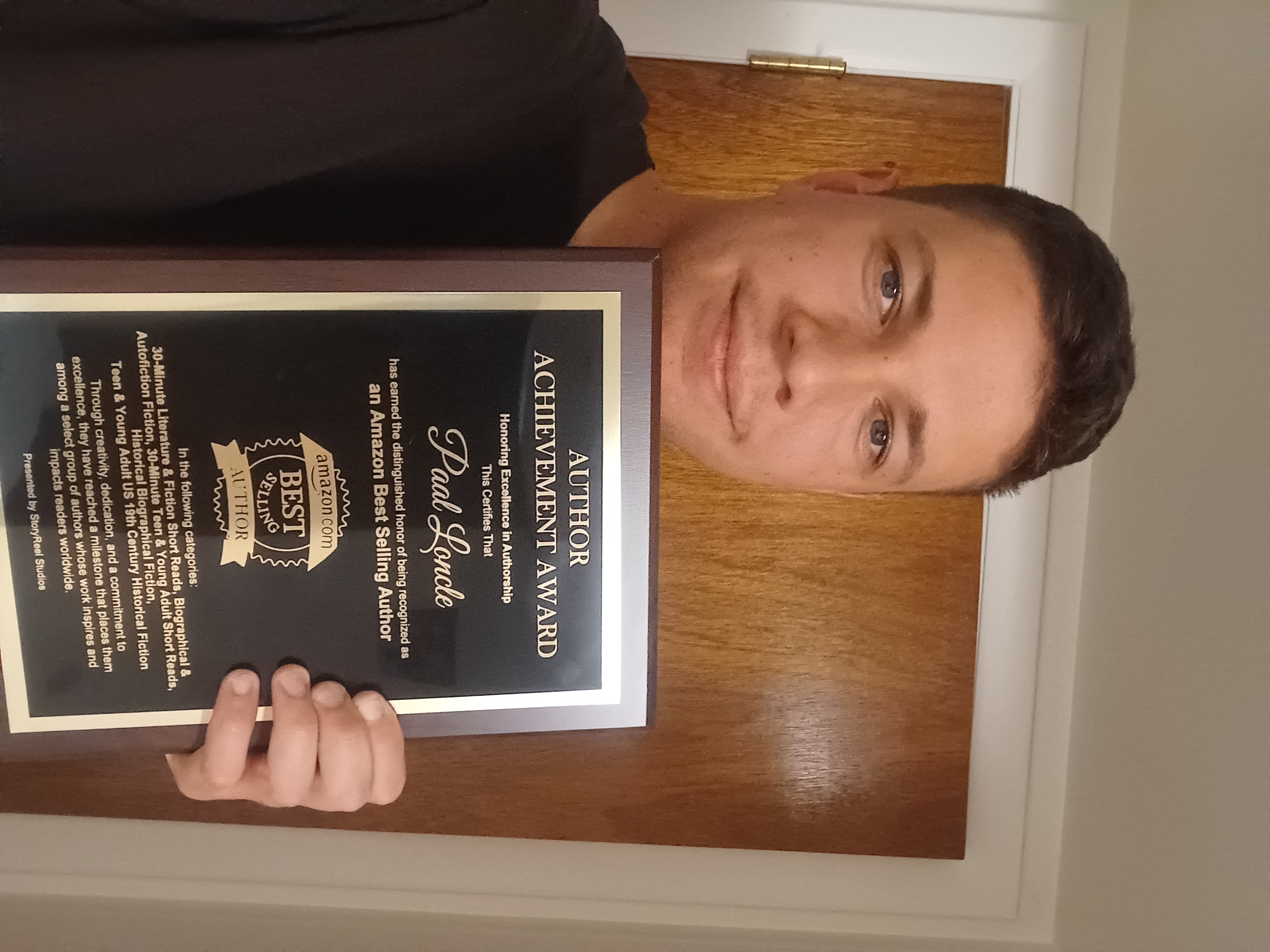
Integrating a professional voice into your semester planning provides a landmark event for your curriculum. The impact of such an interaction often lingers long after the speaker has left. It inspires a renewed sense of literacy and a deeper curiosity about the complexities of human nature. These sessions can be customized to align with specific curriculum goals, whether you are exploring the frontier dynamics in Custer: The Last Cavalier or the aerial tension of The Ugly Skies on New Years. This professional supplement to your book talk for history classes ensures that the past remains a vibrant, urgent topic of study. To bring this cinematic experience to your students, you can Book Paal Loncle for an immersive history book talk or author event.
Resurrecting the Human Pulse of History
Transforming the classroom into a landscape of historical inquiry requires a commitment to both intellectual rigor and narrative atmosphere. You've explored how a cold open and the careful selection of primary artifacts can bridge the gap between dry data and the human spirit. By navigating the historian's guardrail, you ensure that every book talk for history classes remains ethically grounded while capturing the dramatic urgency of the past. This methodical approach turns students from passive observers into active witnesses of human ambition and struggle. It's about moving beyond the timeline to find the heartbeat of the era.
To truly elevate your curriculum, consider the impact of a professional voice. Paal Loncle, author of The Ugly Skies on New Years and Custer: The Last Cavalier, brings an educator-led approach to historical storytelling that honors the gravity of every conflict. His cinematic and somber presentation style provides a masterclass in how meticulous research becomes a living, breathing story. Take the next step in bringing history to life for your students. Inquire about an Author Talk or Educational Event with Paal Loncle to experience this immersive storytelling live. The past is waiting to be rediscovered.
Frequently Asked Questions
What is the ideal length for a book talk in a history class?
A duration of 10 to 15 minutes is ideal to maintain cinematic tension without exhausting the students' intellectual focus. This window allows for a high-stakes introduction and a brief exploration of the internal struggle of historical figures. Longer presentations often slip into a dry recitation of facts where the dramatic urgency of the era is lost.
Can I use historical fiction in a serious history curriculum?
Yes, historical fiction is a powerful tool for building empathy and driving students back to primary research. When delivering a book talk for history classes, fiction serves as a gateway to historiography by providing the "human pulse" that academic texts often lack. It should be used alongside non-fiction to highlight the truth between the lines of the historical record.
How do I handle controversial historical figures during a book talk?
Approach controversial figures by presenting them as complex, flawed individuals rather than static icons or villains. Focus on the internal struggle and the specific historical context that shaped their choices, such as George Armstrong Custer's ambition. This intellectual distance honors the complexity of the subject matter while encouraging students to analyze the "why" behind difficult actions.
What primary sources work best to support a narrative presentation?
Personal artifacts like weathered letters, frantic telegrams, or localized maps work best to ground a narrative presentation in physical reality. These sources act as an anchor for the soul of the story. They provide a voice to the past that reinforces the authenticity of the cinematic atmosphere you've established in the classroom.
How do I engage students who say they "hate" history?
Shift the focus from memorizing dates to the visceral experience of human conflict and survival. Students who find history dry often respond to high-stakes scenarios where the outcome was uncertain. By highlighting the dramatic urgency of a specific moment, you transform the archive into a living project that feels relevant to their own understanding of human nature.
What are the benefits of booking a professional author visit over a traditional lecture?
A professional author visit provides a practitioner’s perspective that a traditional lecture cannot replicate. These speakers, who have spent years researching specific conflicts for works like The Ugly Skies on New Years, demonstrate the art of the past. They inspire deep historical inquiry by showing students that history is a field of active creation rather than passive memorization.
How can I assess student engagement after a book talk?
Move beyond rote testing and assess engagement through the quality of the unanswerable questions students pose during the discussion. Look for a shift in their inquiry from "What happened?" to "What would you have done?" A successful book talk for history classes is measured by the students' willingness to cross-reference narrative fiction with primary sources.
Where can I find trailers for historical fiction books to use in class?
Author websites and major publishing platforms often host cinematic book trailers designed to build atmospheric tension. These visual aids are excellent for setting the scene before a reading or presentation. You can also find curated resources for historical fiction on professional author platforms that specialize in the somber exploration of historical conflict and ambition.


